
Why I Loved Learning In The Army But Hated School
But It’s True.
I found school uninspiring. I struggled to see the relevance of much of what I was being taught and, if I’m honest, I couldn’t wait to leave.
What changed my life wasn’t university.
It wasn’t a degree
It wasn’t even my Master’s.
It was joining the Junior Leaders Regiment Royal Engineers at the age of 16.
It Was The Education
As a young soldier, we spent our time developing military, engineering and leadership skills, but we also attended formal education. I assumed it would be exactly the same as school.
I couldn’t have been more wrong.
Many of the teachers were former members of the Armed Forces themselves. They understood the world we were entering and, more importantly, they understood how to make learning relevant.
For the first time, I could see why I was learning something.
- It wasn’t about passing a test.
- It wasn’t about ticking a box.
It was about becoming better at my job, developing my potential and preparing for greater responsibility.
- When learning had purpose, I paid attention.
- When learning felt relevant, I became engaged.
- When I became engaged, I started enjoying learning.
- Looking back, that was the moment everything changed.
Within a year, I had retaken many of the qualifications I had left school with and achieved significantly better results. In fact, the worst of my new results was better than my best result at school.
What Changed?
- Not my intelligence.
- Not my ability.
- Not my potential
What changed was my attitude towards learning.
- I wanted to improve.
- I wanted to develop.
- I wanted to become the best version of myself.
Learning stopped being something I had to do and became something I wanted to do
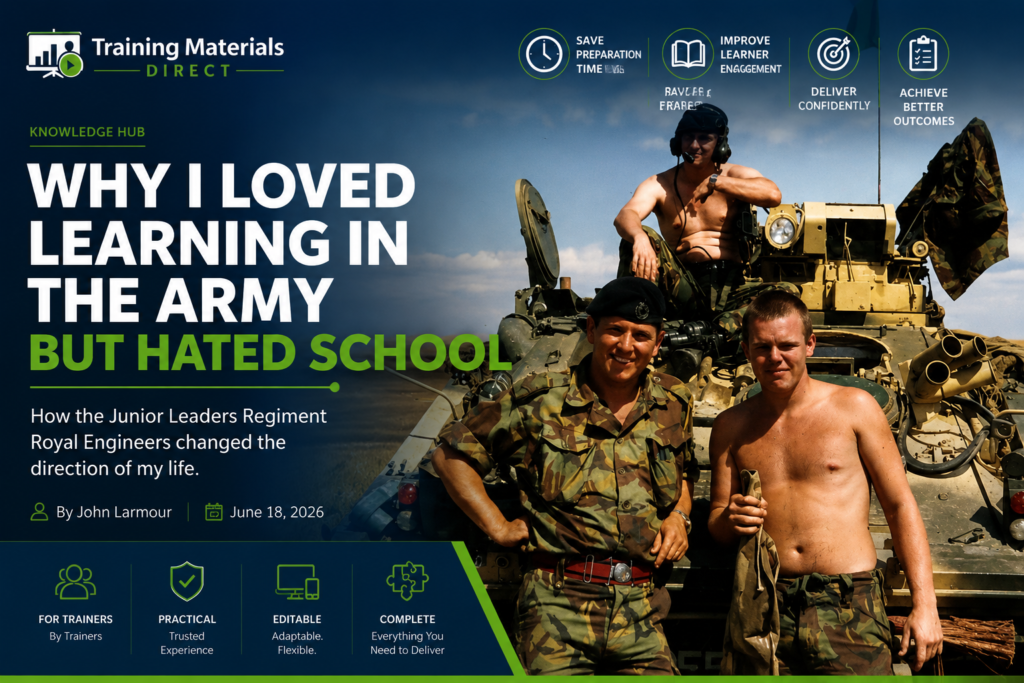
That Change Would Influence The Rest Of My Life.
During my time at the Junior Leaders Regiment Royal Engineers, there was an expectation that you would develop, improve and take on greater responsibility. Nobody focused on limitations. The focus was always on what you were capable of becoming.
Looking back, it’s easy to see why so many former Junior Leaders went on to achieve success both inside and outside the Armed Forces.
Some became senior military leaders.
Others became business leaders, managers, trainers, teachers and entrepreneurs.
The Army wasn’t simply teaching us skills.
It was developing confidence, resilience, responsibility and belief in our own potential
In many ways, we were being prepared for greatness in whatever path we chose to follow.
I remain incredibly proud of having been part of the Junior Leaders Regiment Royal Engineers. Although the programme ended in 1991, its impact continues to be felt through the many people whose lives and careers it helped shape.
For me, it provided something I had never found at school: purpose, encouragement and belief in what I was capable of achieving.
After a year with the Junior Leaders and a further three months developing engineering skills, I was posted to Germany at the age of 17½.
Not even old enough to buy a pint back home.
Life Had Changed Very Quickly.
What hadn’t changed was my growing love of learning.
I developed a passion for reading, self-development and continuous improvement. Over the years, that passion became a habit.
Throughout my life, I have tried to learn at least one thing personally and one thing professionally every year.
That simple principle has shaped both my career and my life.
Years later, while studying for my Master’s degree in Leadership and Management, I found myself recognising many of the theories being taught.
Not because I had studied them before.
Because I had lived them.
Concepts such as leadership, teamwork, responsibility, resilience and personal development weren’t new ideas to me. I had first experienced many of them as a 16-year-old Junior Leader.
The Master’s gave me the academic language and frameworks to describe what I had already seen in practice.
People Often See The Qualification.
What they don’t see is the journey behind it.
I was the first person in my family to gain a degree and later a Master’s degree.
Not bad for someone who hated school.
When I put MSc after my name, it isn’t about status.
It’s a reminder.
A reminder of the young man who left school with poor results.
A reminder of the Junior Leader who discovered a love of learning.
A reminder that potential is often hidden until someone finds the right environment, the right purpose and the right encouragement.
I’ve been asked why I never pursued a doctorate.
The answer is simple.
I don’t feel I have anything left to prove to anyone else.
The qualifications were never about impressing other people.
They were about proving to myself what was possible.
The greatest lesson I learned wasn’t leadership, engineering or management.
It was that learning can change the direction of a life.
The Army didn’t teach me to love education.
It Taught Me To Love Learning.
That lesson changed the direction of my life.
It helped a young man who left school with poor results become the first person in his family to gain a degree and later a Master’s degree.
More importantly, it taught me that potential is often hidden until people are given the right environment, the right encouragement and a reason to learn.
That’s why I still believe every learner deserves a better learning experience.
Because when people discover what they are capable of, amazing things can happen.
I know.
I’m living proof.
Explore The TMD Framework™
Continuous Improvement™
How it evolves